Jordan: Petra

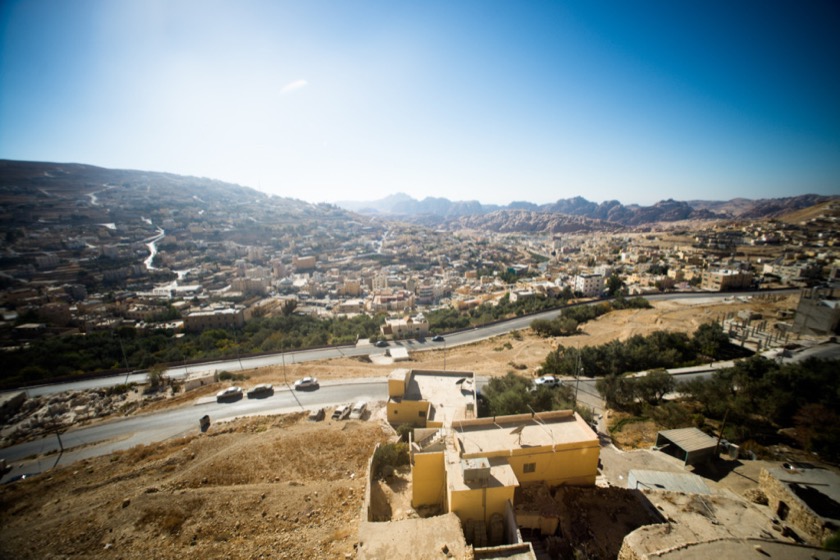
Wadi Musa, which means valley of Moses, is right next to the ruins of Petra. Wadi Musa, which means valley of Moses, is right next to the ruins of Petra.

After trying to wash every last bit of salt off of our bodies after soaking in the Dead Sea, Rachael and I headed south along the coast and then up into the mountains toward Petra, the ancient Nabatean city nestled among towering pillars of sandstone. The drive took us from 1,400 feet below sea level to several thousand feet above it, as we wound up old, mostly deserted roads. The small towns we drove through on the way seemed pretty far off of the tourist trail, based on the gawking looks from adults and the waves from children.
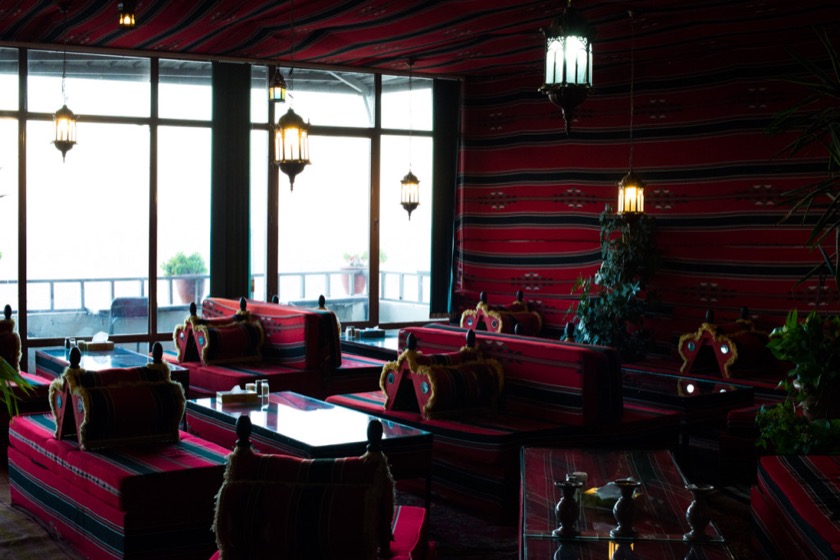
The beautiful common area at the Rocky Mountain Hotel The beautiful common area at the Rocky Mountain Hotel

Once we arrived in Wadi Musa, the city next to the ruins of Petra, we checked into a small hotel that Rachael had expertly researched online called the Rocky Mountain Resort. It was a decent and affordable place to stay, though its real shining quality came from the common space on the top floor. Not only was the view of Wadi Musa magnificent, but the whole place was outfitted with traditional carpet walls, floors, and roofs like a Bedouin tent. We ate our breakfasts and dinner here while during the few days we spent in Wadi Musa.
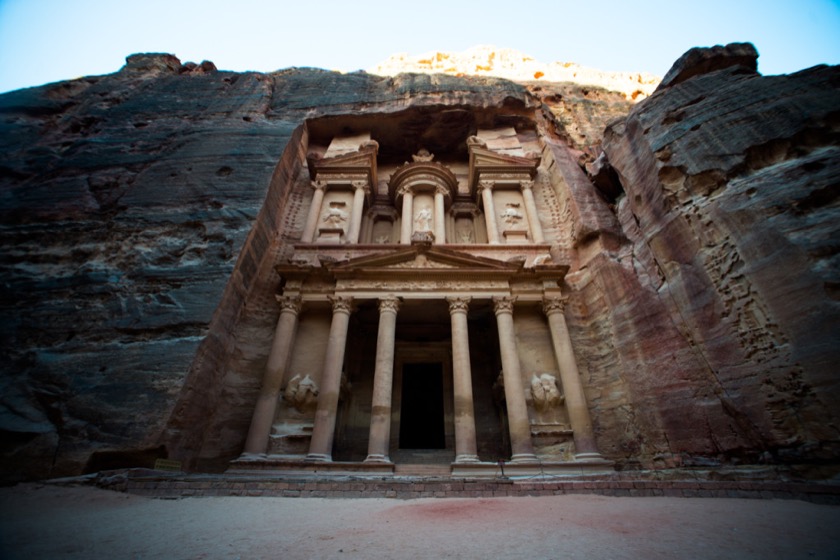
This is Al Khazneh (The Treasury, in English). You probably recognize it from an Indiana Jones movie. This is Al Khazneh (The Treasury, in English). You probably recognize it from an Indiana Jones movie.

If you came upon Al Khazneh (The Treasury, in English), you’d almost certainly recognize it. You may have seen it in a book, or more likely, in the third Indiana Jones movie, The Last Crusade. It’s one of the first ruins you see when you walk into Petra, and easily the most detailed. But unlike in the movie, it’s admired from the outside. Apparently visitors were once allowed entrance, but not anymore. That’s not such a shame, though. Rachael and I went inside a few of the other ruins, and they’re little more than empty, featureless rooms carved into the sandstone.

While walking through the ruins of Petra it’s easy to get the sense that you’re seeing the remnants of palaces, markets, and other buildings, but apparently the ruins were built as tombs for the dead rather than as homes for the living.
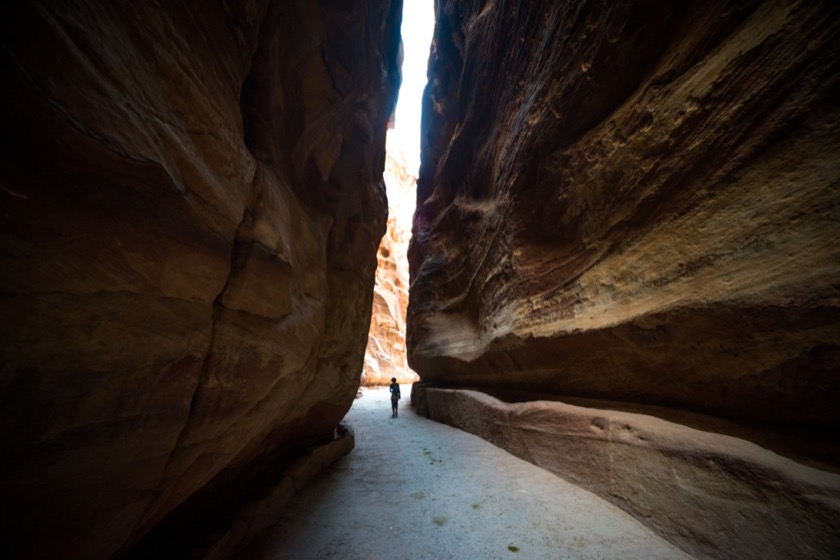
Rachael walking out of Petra through the Siq Rachael walking out of Petra through the Siq

The size of the ruins at Petra is impressive, as is the architecture and the way in which they are carved straight into the sides of cliffs. But the thing that I liked the most about Petra was the way we arrived. After purchasing tickets and walking down a dirt path for half a mile or so, we came upon what’s know as the Siq (pronounced “sick,” I think), a slot canyon with walls rising hundreds of feet above. As we walked through the Siq, it became narrower and narrower, until it was just wide enough to accommodate the two of us walking side by side.
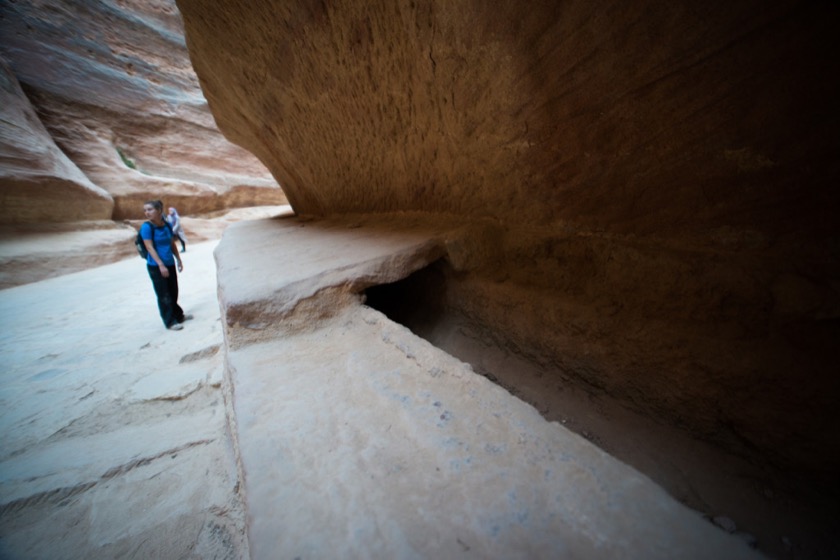
Old pipes carved into the sandstone Old pipes carved into the sandstone

Along the walls of the Siq there runs an old terracotta pipe that was used to carry fresh water into the city. Like the rest of the ruins at Petra, it’s carved straight into the sandstone.

Rachael and I spent two days exploring Petra, and hiked at least a dozen miles in the process. I don’t know why I had this idea, but I assumed Petra would be a bunch of ruins all relatively close to one another. In reality, though, they are very spread out, and we didn’t even get to all of them. Maybe it’s better to think of Petra as a few long, steep hikes that take you to a bunch of unique ruins. And the best part about this is if you show up early and strike out on one of the more difficult hikes, you’ll have most if the ruins all to yourself.

We wandered into one of the canyons and quickly found ourselves separated from other tourists and any sign that we were still in Petra. Olive and orange trees grew on either side of the path, and a small stream ran alongside it. We spotted some goats high up on one of the walls of the canyon, and them came upon their herder and his dog. The goatherd coaxed the goats back to the floor of the canyon and then began to lead the goats back downstream. We walked behind him and after a few paces he asked us the inevitable question, “Where you from?” America, we said, and then he handed us a couple oranges he’d grabbed from a nearby tree. They were delicious. As we began to part ways I offered him a dinar for his generosity, which refused until I insisted, saying it was the best orange I’d ever tasted. It wasn’t too far from the truth.
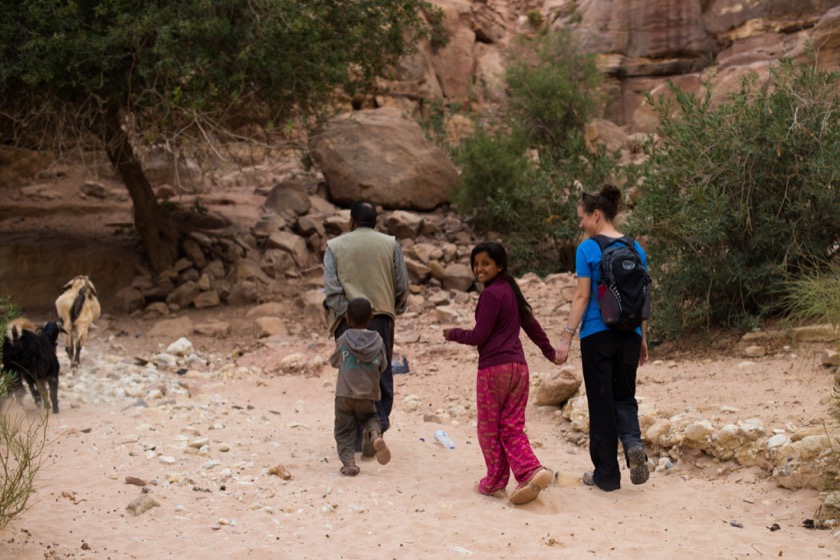
We wandered up a canyon and met a Bedouin family who invited us to share tea. We wandered up a canyon and met a Bedouin family who invited us to share tea.

Once we had walked a few paces away he called after us in broken English. He said that his family was waiting nearby and wanted us to join them for tea. My gut reaction in these situations is to say no, because scams can be shrouded in generosity. But it seemed innocuous enough, so we followed him to a landing up on the rocks where he keeps his goats at night. Sure enough, three young kids ran out to greet him, and he handed each of them an orange from his pocket. He hollered something at his wife and motioned for us to follow.

He showed us the pen where he keeps his goats, a large room carved into the sandstone that was probably a Nabatean tomb 2,000 years ago. It was a good example of the fact that Petra is not simply a bunch of roped off ruins. I saw tombs off the beaten path being used to house souvenir shops, irrigation pipe, generators, and even one truck. I guess you could say that it violates the purity of the place, but it’s hard to fault the Bedouins for taking advantage of tombs built by their ancestors.

We sat with Solomon, his kids, and his wife for about an hour sipping Bedouin tea, a really sweet black tea mixed with sage. We didn’t have a lot of English in common, but frankly there just isn’t always that much to say. I let his kids play with my camera and then Solomon offered to share a cigarette with me, but I declined. Then he got out his wallet, laid out pictures of his wife and three other women, and asked me a question: “Of all my wives, which is best?”

Jordan: The Dead Sea

Two boys riding a donkey near the Dead Sea

A few weeks ago Rachael and I took our first vacation out of Qatar since we arrived in August. We chose Jordan for a variety of reasons: only a few hours away, stable and affordable, and it would give us a chance to visit a country that had a lot of real history behind it.

My initial impression of Jordan, both from the air and now on the ground, was of a desert country with more green and hills than I expected, though not enough to make it feel like home. Based on the little I’d seen so far, it looked a lot like Lebanon, with similar beige, concrete architecture and dusty, but still vaguely green vegetation.

We spent our first afternoon driving the short distance to Madaba, a town halfway between the airport and the Dead Sea. It didn’t take us long, and luckily the driving was uneventful, save for a few warning lights popping up on the Renault. I had only driven in a foreign country on one other trip (to Norway), but thankfully the signs and rules seemed straightforward and there were only a few cars driving the wrong way down the freeway, and they mostly stuck to the shoulders.

A group of kids we met walking around Madaba

We checked into our hotel in Madaba and then wandered around the town taking pictures and looking for a decent place to eat. We happened upon a liquor store by accident (I swear) and were briefly followed by an overly friendly drunk guy who really wanted to be our friend. Needless to say, this never happens in Qatar.

One thing about our hotel that we didn’t think about until four the next morning was its proximity to the local mosque, or more specifically, the loud speakers at the mosque which play (actually blare is a better word) the call to prayer. I wouldn’t have changed our reservations just because a mosque was close, but by 4:45 a.m., when the speaker had been reminding us to pray for the better part of an hour, I started to reconsider our decision.

Looking out at the Promised Land

The next day we headed for the Dead Sea. Along the way, we stopped at a Christian religious monument called Mount Nebo, the point where Moses was said to have looked out at the Promised Land. There was a good view from there of Jericho and the Dead Sea, but the real attraction were the scores of Indians who were visiting the monument as part of a Christian tour group. They were easily identifiable by their matching hats and backpacks, and one of them handed Rachael a pamphlet all about how Jesus loves her (this is another thing that I don’t expect to ever happen in Qatar).

We wound our way down the mountain to the Dead Sea, our poor Renault shaking and rattling and warning us the whole way. In fact, that damn car was the most stressful part of our entire trip. It never broke down or caused us any real problems, but it seemed to be reminding us that it could go at any minute, not unlike the camel we saw being butchered by a group of Bedouins (I think) in a camp by the side of the highway.

Reading a book in the Dead Sea

A long time ago I saw a photograph of an old man floating in the Dead Sea and reading a newspaper. It seems impossible, actually, and if it doesn’t, hop in a pool and try to float so high that you can keep an entire newspaper from getting wet. But the Dead Sea is so salty, in fact, that it is possible, and you’re all but required to photograph yourself doing the same thing. According to our guidebook, it’s the second saltiest body of water with a 30 percent salt content by weight (ten times that of the ocean). It’s also the lowest point of land on Earth’s surface, a full 1,400 feet (427 meters) below sea level. I stuck my tongue in it, which I don’t recommend, not so much because it’s so salty, but because it feels like dipping your tongue in bleach.

That’s it for this post. I’ll cover our other two destinations, Petra and Wadi Rum, in a few days.

Teaching English vocabulary with men's fashion accessories

A pretty regular outfit for me

Last week I was helping out one of my fellow teachers in his music class. We were seated on the floor in a circle with about twenty students, and next to me was a girl in third grade who kept tugging on my sleeve.

"Mister, mister," she kept saying, but each time I'd direct her attention back to the music teacher and his lesson. She wanted to ask me a question, but I didn't want to feed the interruption. This went on for most of the class, and at the end, while we were leading the students back into the hall, she pulled me aside and prepared to ask her question.

"Mister, what is this thing?" She pointed to the tie clip I had clipped to my front.

"Oh, that's a tie clip. It holds my tie to my shirt."

She stopped, puzzled, and asked, "But why?"

Legitimate question, I guess. I tried to swing the tie around vigorously to make the tie clip seem really necessary, but she was dubious. I then tried to explain that sometimes the tie dips into my food when I eat, but that wasn't a very good explanation, either. So I settled for saying that I wore it because I liked it. That explanation may not have satisfied her, but it was good enough for me.

A few days later I wore another tie clip and a different girl came up to me in class, pointed to the clip, and asked, "Mr. Alex, what is this thing?"

"It's a tie clip," I said. "It holds my tie down to my shirt."

"Well, I don't like it."

I guess Qatar just isn't tie clip country. In fact, I might be the only person in the entire country who ever wears them.

Asking for permission

13736-2013-Oct-13-AMJ-X
One thing I took for granted about life in the United States until I came here was that if I wanted to do something, like set up a bank account, say, I could do it. I didn't have to ask permission from my employer, or from the government, or from my family. I could just walk into a bank with a little bit of money and an I.D. and I'd be set. It's the same deal, for the most part, with renting a home, getting a driver's license, traveling, and a million other things. There are other hoops to jump through, but I don't have to solicit letters of permission to go about the basic functions of life. In Qatar, things are different.

Here's a short list of things that require an employer's permission in Qatar:

  • Getting a driver's license
  • Renting a home
  • Opening a bank account
  • Buying alcohol
  • Switching employers
  • Leaving the country

When Rachael and I first considered working in Qatar, that last one was pretty scary. Would we be trapped here and unable to go home? Under normal circumstances, probably not. But if we racked up a ton of debt and then tried to flee the country? Then we'd almost certainly have a problem.

All of this stems from Qatar's kafala system, which basically means your employer sponsors your travel to Qatar and your residency in the country, and gets to say what you can and cannot do while you're here. There are parallels to other immigration policies around the world, but Qatar's is quite a bit more strict.

While it's customary to complain about this sort of bureaucracy, for Rachael and me it's really just a minor inconvenience. But for many of the country's laborers (and even some of its executives) the kafala system is much more serious business.

The point is that as an expat, you're here and happy by your employer's good graces. It's quite a departure from other employment systems I'm familiar with, where there are there are systems and authorities to protect you if you fall out of favor with your employer.

None of this is meant to frighten, but it's something that's different about Qatar and I thought it'd be interesting to write about.

First days of school

2013-09-01 13.03.15

I missed the first day of school. As you're probably learning, paperwork rules all in Qatar, and mine was held up. The chest x-ray I took at the Qatar Medical Commission that was supposed to prove that I've never had tuberculosis came back inconclusive, so I had to spend the first day of school back at the Medical Commission enduring the radiological onslaught of more x-rays. It took a few days for the results to come back, though, so I actually missed the second day, too. And the third. And the fourth.

On Wednesday night, though, I got word that I'd cleared my second round of x-rays and could return to school on Thursday, which in Qatar is the fifth and final day of the work week. Except now I had a cold and a severe sore throat, so it wasn't the sort of triumphant entrance I'd been hoping for. But you can't call in sick on your first day, especially since it was a first day that'd been delayed for nearly a week.

It's now three weeks later and I feel like I'm starting to get into a groove of school here. I haven't been doing much substituting, since since only one of the teachers I substitute for has called in sick, but I have been spending a lot of time in classrooms helping out teachers with their lessons.

I'm in charge of filling in for teachers in first and third grade, so that's where I've been focusing my time. On top of that, my personal inclination is toward math and the sciences, so I've been spending a lot of time in a first grade math and science class helping the students out with basic math. We'll get to the science lessons eventually, but for now, just the basics.

What I didn't expect

2013-08-25 18.42.24

In my previous life working in journalism, one of my favorite questions to ask someone who had gone through a major experience or change in their life was 'What didn't you expect?' It's really efficient at cutting through the boring stuff and getting at whatever was interesting, exciting, or surprising. Having been in Qatar for almost three weeks now, I think it's a good time to ask the same question of myself.

In stock

Rachael's dad tried to convince me on several occasions that the stuff I was stocking up on in Portland would probably be available in Qatar, too. And for the the vast majority of supplies I bought, he was right. They can plenty of coconut oil here, and contact lens solution, and peanut butter, and none of it is very expensive. I've even found fresh blueberries and blackberries in good condition flown in from Oregon. The quality probably isn't as high I'd find back in the United States, but it'll do.

The only thing I've yet to find here are those special dish gloves that are designed to fold up at the cuff so the water doesn't drip down your elbow. Luckily I brought five pairs in my suitcase. And in case you were looking for I Can't Believe It's Not Butter Spray (I wasn't), you can find it here.

Under construction

I knew that there would be building going on in Qatar, but I had no idea of the scale of it. Basically, it's almost literally everywhere. If I walk outside and look around, I'm bound to see at least one (but probably significantly more) construction projects. They're building office buildings and apartment buildings and villas and roads and an airport. It feels like there was nothing here just a few weeks ago and then the emir said, "Alright, let's get started!"

One of the downsides of all this construction is the dust that it kicks up into the air. You can see it along the skyline as a sort of brown haze, and a thin film of dust covers just about everything that isn't cleaned regularly, since there isn't much rain or wind to wash it away.

The picture below shows a massive construction project near where we're living. I don't have a good sense of the scale, but I'd guess it's about 80 acres or so, and it's being marketed as the new downtown of Doha. I've never seen more cranes in one place.

13429-2013-Aug-29-AMJ-X

Part of the family

Who you work for in Qatar seems to go a long way in determining what you're experience is like. Our employer is a massive non-profit run by the royal family. It reminds me a bit of being connected to Vito Corleone. Not in the criminal sense, mind you, but because we're very well taken care of.

Here's a case in point: A few days ago we had to go to the Medical Commission to get tested for HIV, hepatitis, and tuberculosis. It's standard procedure for anyone moving to Qatar, whether you're working in a school or on a construction site. That means there were hundreds of people in line when we arrived, but because of who we work for, we didn't have to wait behind them. Instead, a Qatari public official met us at our bus, walked us straight to the front of the line, and then guided us through the process of having our blood tested and our chest x-rayed. We were in and out in about an hour.

Do we really need a car?

When I first started looking into what life might be like for us in Qatar, owning a car played a large role. Our employer provides a transportation stipend, used cars are relatively inexpensive, and we figured we'd need one to get to work. But once we arrived we learned that we'd have a bus taking us to and from school, at least for the first year. We've also been using local taxis and limousines (basically just a fancier car without a meter) which will take you anywhere in town for five to ten bucks.

Needless to say, all of this has me wondering whether or not owning a car is worth it. If we relied on the school's bus and taxis and limousines we'd trade in a bit of freedom but probably save a lot of money in the process. We're not making a decision yet, but we're not rushing into buying a car, either.

The heat isn't that big of a deal

It is incredibly hot here, but we spend so much time inside that it almost doesn't matter. Everything is air conditioned, from apartment to bus to work to bus back home again. Even when I do go out, though, it's bearable. As long as I'm out of direct sunlight, sweating profusely has been enough to keep me comfortable. Completely drenched, but comfortable. Last night Rachael and I sat on a curb for half an hour or so and waited for a cab. It was about 95 degrees outside at 9 p.m., but with a slight breeze it was almost pleasant.

I'm sure there have been a few days here where we haven't spent more than three minutes total outside. Of course, that's a bit of a double-edged sword. Cabin fever has set in a few times, including this morning when I decided to go for a run outside instead of in the gym. I won't be doing that again until the temperature drops below 90 degrees.

An army of helpers

One good way to imagine Qatar is as a social experiment in which money is no object and there is no shortage of labor. I saw this most dramatically when the movers showed up at our temporary apartment to deliver the boxes we'd shipped from Portland back in early August. At first it was just two or three guys unloading a trunk, but once it came time to take them up the elevator and into our apartment, ten guys wearing beige coveralls who appeared to be from somewhere in South Asia showed up out of nowhere and began shuttling our boxes like cartoon firemen shuttling buckets of water. It didn't take longer than five minutes for them to move 800 pounds of stuff up an elevator shaft and into apartment. It was incredible.

There's a similar situation at the school where we work. Not only are there adequate teachers and assistants in each classroom, there are also a team of security guards manning the entrance gates and walking the school, plus at least a dozen "helpers." Their uniforms say something about a cleaning company, and they do clean, but they also help teachers with projects like decorating classrooms. It's an odd, but welcome, arrangement.

I'm sure I'll be able to put together another one of these lists before too long, but I'll end this one here.

Driving out of Doha

[youtube https://www.youtube.com/watch?v=2K8IScES7s8]

The other day I posted a clip of what one might see out the window driving through Doha. Today on our way to school in Al Wakra I took another short video out the window. There's not much there besides open desert and a little bit of construction, but it'll give you a sense of the thirty-ish minute commute.

Driving through Doha

[youtube https://www.youtube.com/watch?v=-EwcCbVC99c]

When we first started looking at jobs in Qatar, I found it really hard to picture, even with pictures. I knew that there were tall buildings and nice roads, that there was sand, etc. But what I didn't know was what it felt like to drive through the place. So a few days after we arrived, I made a video of what it looks like to do just that.

It's short, and I can't remember where I took it, but it should give you a sense of what it looks like to drive through town here. A few things you'll see that aren't uncommon: construction, nice cars and roads, and a cloudless sky.

Home is where you have pictures and magnets and a fridge

13396-2013-Aug-27-AMJ-X

As I mentioned in a previous post, one of the few downers we've encountered since our arrival is that we're living in temporary housing until our permanent place is set up. And on top of that, we don't know exactly how temporary our current living situation is. Will we be here for a couple weeks or a couple months? We just don't know.

For the most part, this really isn't that big of a deal. The apartment Rachael and I are living in right now is spacious, clean, comfortable, and safe. The air conditioning works, and although there isn't a view or much natural light, it's not a bad place to live. The downside, though, is that we don't really know how much to unpack and how much to get settled. It didn't take long after we arrived last week for me to start to feel like we were living in a hotel. There are all the trappings of a modern house (fridge, cookware, bedding, etc.), but all of it is sort of cheap, and none of it makes me feel at home.

13399-2013-Aug-27-AMJ-X

So one night, out of a kind of unannounced desire to do some nesting, Rachael and decided to start rearranging furniture and decorating. It began by breaking out some magnets a friend gave us recently (thanks, Maura!) and photo prints we'd brought from home (many of these came from my sister, Kjerstine). We put a few of ourselves and our family on the fridge, and even that made a gigantic difference. I'm not sure why, exactly, but having a picture of someone you love stuck on a fridge says, 'You're home.' Then we broke out some other picture frames we'd packed and set them up in our entryway. Rachael had a wall hanging that we used to replace some ugly, generic, hotel room art, plus a painting from Ecuador that we propped up in the kitchen. We also put down some nice pieces of fabric on the coffee table and our breakfast table.

13395-2013-Aug-27-AMJ-X

Then, it was on to the furniture (see above). We turned one of our couches a few degrees to make the living room more cozy, angled the dining room table to make it easier to move through the apartment, and found a cloth to cover up the television when we're not watching it (any modern Portland hippie worth her salt knows this trick).

All of this only took us about 15 or 20 minutes, but oh, what a world of difference it made. We may be in temporary housing in a dusty town in the Middle East, but I'll be damned if it doesn't feel a little bit like home.

Aloha from Doha

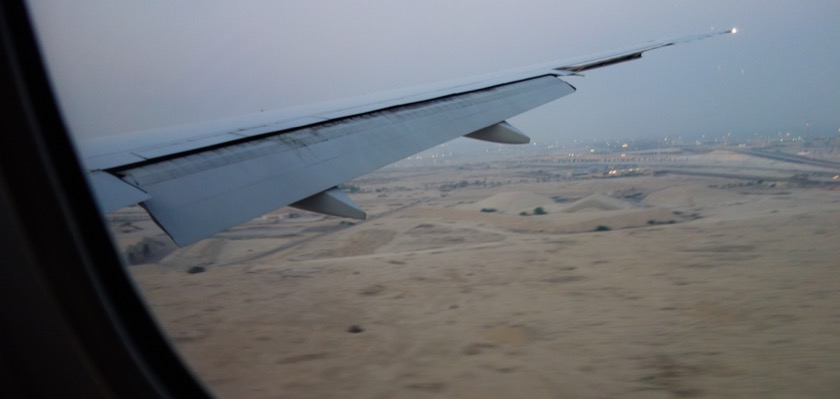
After leaving Chicago on Monday evening, we flew up over Canada, just south of Greenland, through Eastern Europe, and down over Iraq and the Persian Gulf. When we first spotted Doha out the window, it looked like a big, beige nothing (see below). We flew south of the city and then came back around, passing over the school we'll be working at in a few days.

13333-2013-Aug-20-AMJ-X

The flight was about 12 hours long, which passes quickly when you can choose from hundreds of movies, including classics like Back to the Future, The Godfather, and Big. I'd heard a lot about how nice Qatar Airways is, and it was, but it didn't blow my socks off (though they do give you a pair to wear around the plane, which is pretty cool). The main differences I noticed from other international carriers like Lufthansa was that the flight attendants were constantly coming through the aisles offering drinks and moist towelettes and there was perfume in the bathrooms.

Qatar is building a new airport for Doha, but it wasn't ready when we arrived, so we deplaned into the hot, sticky air that everyone remembers about their first arrival and then took an air-conditioned bus to the immigration building. To me, this was the moment of truth. Surely something went wrong with our paperwork, or our passports, or something else, and they'd turn us back at the gate. But they didn't. We talked to a young man with braces who wore a spotless white kandura and keffiyeh (who I assume was Qatari) who smiled at Rachael and me when we said thank you in Arabic (shoo-krawn).

We collected our luggage without incident and began to meet more and more people who will be working at our school. There was a woman from North Carolina, a couple from Vancouver, and other people from elsewhere in North America. The two administrators who'd hired us all in San Francisco were also there.

I wasn't expecting much in terms of organization (better to keep your standards low when doing something new), but I ended up being really impressed. The administrators had packets for each of us with a ton of ton of useful stuff, like phone cards and a few hundred dollars spending money, and information, like what we'll be doing for the next few weeks, where we'll be living, how to get a hold of important people. They made little laminated cards to carry with us that had important phone numbers. They even brought a cooler full of ice water. Nice.

The only bad news that we received on our arrival was that we would have to stay in temporary housing because our permanent accommodation, an apartment in a housing development called The Pearl, isn't ready yet. We don't know exactly when it will be, so for now, Rachael will have to make our current apartment our home.

13339-2013-Aug-20-AMJ-X

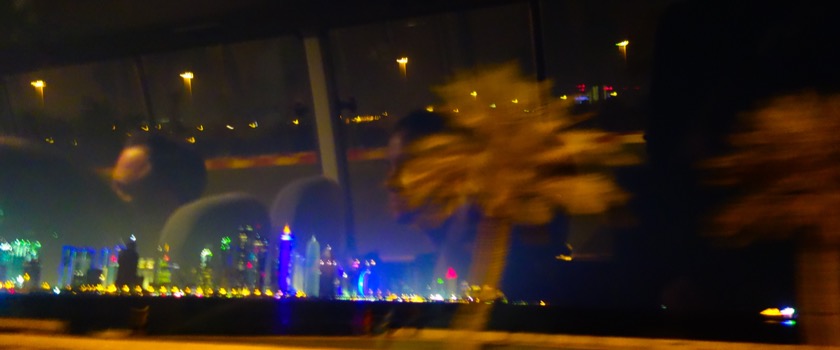
The school's bus and driver took Rachael, me, and the other new employees to our temporary accommodation, which is a nondescript beige (we're establishing a theme here) apartment building in Doha. We got a chance to see downtown Doha from a distance, which was lit up (see above) in bright colors. Our school's principal told me that many of the skyscrapers are empty, built in anticipation of high demand in the future.

We've been here for a few days now, and there's a lot to write about, but in the interest of sparing everyone from a 4,000 word blog post I'll stop here.